
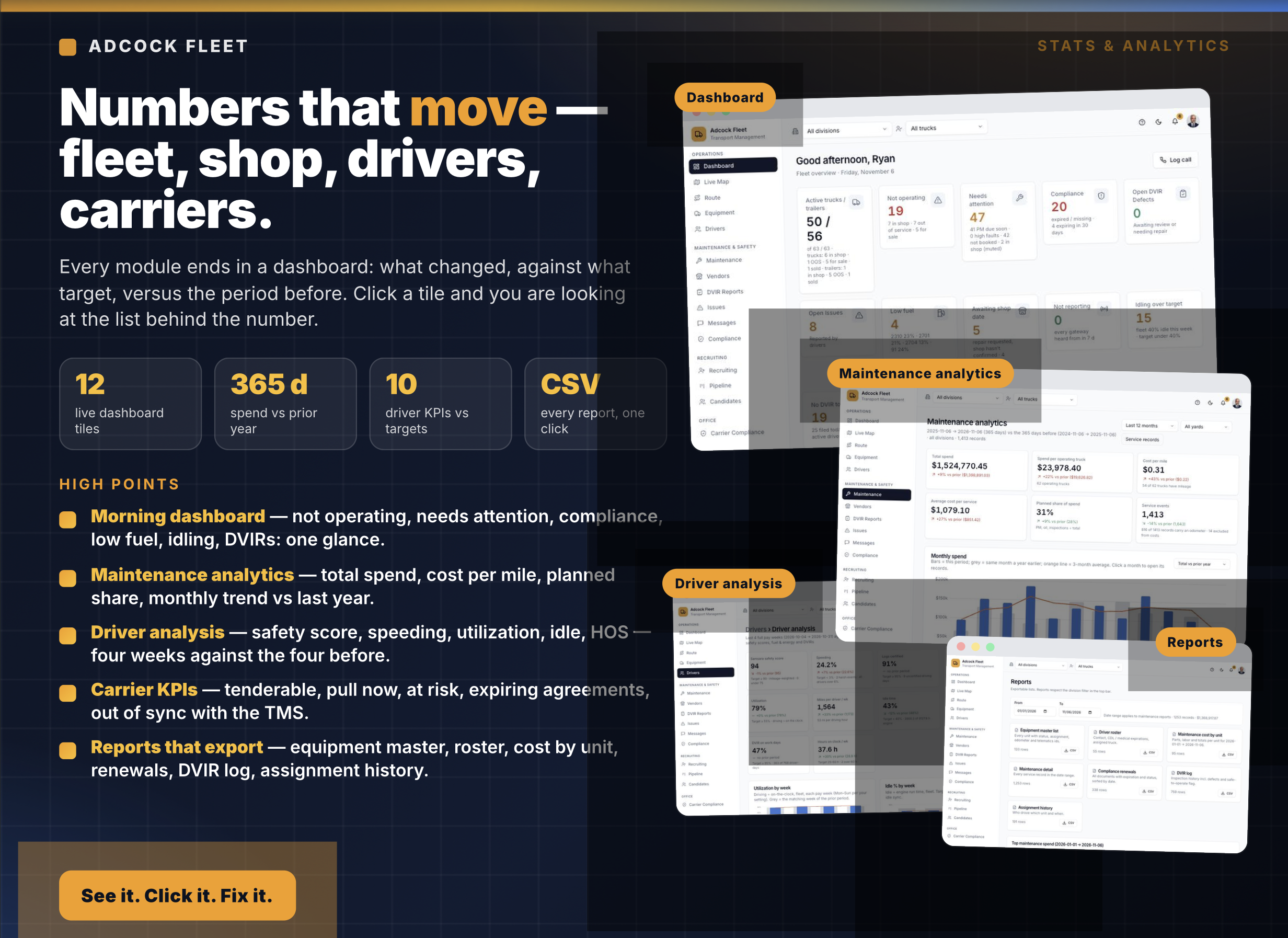
Adcock Transport runs its trucks, drivers, maintenance, dispatch and carrier network on a single fleet system built for the way auto transport actually works. This paper explains what we built, why, and what it changes for the people who ship with us, drive for us and haul for us.
Why we built our own
General-purpose fleet software is built for trucks that carry freight. A car hauler carries nine vehicles with nine VINs, picks some up and drops others mid-route, swaps trailers between divisions, and lives or dies by the condition of a hydraulic deck no dry-van product has a field for. Every tool we tried made us work around it.
The real cost was not the licence. It was the gaps between tools: a DVIR in one app, the fault code in the telematics portal, the shop invoice in a shared drive, the load in the dispatch system, and the insurance certificate in someone’s inbox. Each gap was a phone call, a spreadsheet, or a thing that got missed.
So we built one system around three records that matter in this business: the truck (and the trailer it is rigged with), the driver in its seat, and the load on its deck. Everything else — inspections, faults, repairs, compliance, routing, fuel, carriers, recruiting — hangs off those three. When a driver reports a problem at 2 AM, the person who answers sees the truck, its open faults, its last inspection, the loads on it and the nearest shop that answers at night, on one screen.
One system, one record
The system is an office application for dispatch, maintenance, safety, compliance, finance and recruiting, and a phone app for drivers. Both read the same records, so a change in one place is the change everywhere.
| Module | What it holds | Who lives in it |
|---|---|---|
| Equipment | Every truck and trailer: spec, odometer, PM clocks, governor setting, telematics, costs, financials, economics | Maintenance, finance |
| Drivers | Licence, medical card, assignments, hours, leave, idle, safety score, texts | Safety, dispatch, HR |
| Maintenance | Status board of faults and defects, repairs booked with shops, service history with invoices, analytics | Maintenance |
| Compliance | Every expiring item on a truck or driver, with the renewal chased automatically | Safety |
| Route | Live map, truck-legal routes from the loads in V-LMS, fuel plans against the price table | Dispatch |
| Issues | Problems drivers report or phone in, with the follow-up, shop calls and after-hours stats | Dispatch, support |
| Carrier Compliance | Brokered carriers: contracts, certificates, policies, FMCSA standing, a portal for the carrier | Carrier compliance |
| Recruiting | Candidates from every lead source, pipeline, drip emails, seats to fill | Recruiting |
| Finance (beta) | Weekly accruals per unit: insurance, maintenance, revenue, owner-operator chargebacks, QuickBooks export | Accounting |
A truck is one record from the day it is bought to the day it is sold. Its DVIRs, fault codes, shop visits, fuel, miles, drivers, loads and insurance all attach to that record, so the questions that used to take a week of digging — what has this truck cost us per mile, how many days was it down, should we replace it — are answered on its page.
Divisions are the security line: a user sees the divisions they are given. The dispatcher picker is the working view: pick a dispatcher and every page narrows to their trucks, the trailers paired with them and the drivers in their seats.
Safety and compliance on one board
Every truck has a status board that shows the same thing to the driver, the dispatcher and the shop: active fault codes from the engine, open defects from the last inspection, the repair that is booked for them, and the dash lamps. Nothing on it is typed in; it comes from the truck and from the driver’s inspection.
- Inspections. Drivers do pre- and post-trip inspections in the phone app, with photos. A defect opens on the status board the moment it is filed, and a repair can be booked from it. Inspections also flow in from the telematics platform, so a driver who inspects there is covered too.
- Fault codes. Engine faults arrive from the truck every few minutes, ranked by severity, with a plain-language explanation of what the code means and what usually causes it. A fault that comes back after a repair is flagged as a repeat.
- Hours and idling. Driving hours, on-duty time and idle time come from the trucks daily. Idle percent per driver is checked weekly against the company threshold.
- Expiring items. Registrations, inspections, insurance cards, permits, licences and medical cards each carry an expiration. The system computes what is due, chases the renewal, and marks items not applicable when a driver leaves or a truck is sold, so the list is never padded with ghosts.
- Governed speed. The speed limiter each truck is supposed to be set to is on record, and the top observed GPS speed per day is kept next to it, so a truck running over its setting is visible without a road test.
A sweep runs every morning. Anything due, overdue or newly broken goes to the people responsible for that division, by email, text or notification, as they have chosen.
Maintenance that knows the truck
A shop invoice becomes a service record by uploading it. The system reads the invoice — vendor, date, odometer, parts, labor, total, the work done, whether an A or B service was part of it, and whether it was major work on one system such as an engine, transmission or aftertreatment — and files it against the truck. Years of invoices from the shared drive were imported the same way, so the history is deep.
From that history the system keeps the clocks: when the next PM-A and PM-B are due by miles, what the last one cost, which vendor did it. Repairs are booked with the shop from the status board, the shop gets the request by email or text, the driver gets the reminder the day before, and the invoice that comes back closes the loop.
Miles come from the trucks, not from guesswork. The telematics platform reports each unit’s miles, engine hours, idle time and fuel every day; the system rolls those up by month and uses them for every cost-per-mile figure. A truck is compared with itself over 12, 24 and 36 months and with the fleet by make and age.
The economics follow. For each truck the system holds its value today (the team’s figure, or an AI market estimate scored against our own past sales, or purchase price depreciated), its maintenance cost per mile, its down days over the last year, and a twelve-month comparison of keeping it against a comparable replacement — depreciation, capital, maintenance and downtime on each side — with a plain call: keep, review or replace. A fleet-wide ranking puts the trucks that cost the most to keep at the top. The numbers are computed; the AI only writes the two-sentence note that explains them each month.
Dispatch, routing and fuel
Loads are dispatched in our load management system, V-LMS, and that stays the system of record. The fleet system reads the live loads for every truck and builds the day’s route from them: the vehicles on board and where each drops, the pickups due today, in a truck-legal sequence from where the truck is now. Routes come from Google’s truck routing with our rig’s height, weight and length, so a bridge the truck cannot clear is not on the plan.
The fuel plan sits on the route. Every week the vendor price sheets land and the system reads them into one price table; for each route it finds the stations within the corridor, ranks them by net price less the cost of the detour, and plans the stops the truck’s tank actually needs, with a reserve. The driver sees the plan in the app with one-tap navigation; the office sees the whole fleet’s plans on the route board.
Before routing is switched on fleet-wide, it is proving itself. A handful of trucks run a route trial: for each run of loads the system records what it planned — miles and gallons from where the truck was — and what the truck actually drove and burned, from its own odometer and fuel report, with both drawn on a map. Runs follow the day as dispatch works it: a run opens when the truck has work due, stays open as cars go in route and get delivered, closes when the last one is dropped or new work arrives, and the empty leg back to the yard is measured as its own trip. The differential is the proof, truck by truck, before anyone is asked to follow a route.
Carrier compliance
Part of our freight moves on brokered carriers, and every one of them is held to a written set of requirements before a vehicle is handed over: authority and safety standing, auto liability and cargo coverage at our limits, our companies named as additional insured and certificate holder, scheduled autos, and a signed carrier agreement.
The process runs in the system, not in an inbox. A carrier gets a link to a portal, uploads its paperwork there, and sees a plain checklist of what is accepted, what is short and what is still needed. Each document is read on upload: the certificate’s lines, limits and dates, the additional-insured box, the policy’s exclusions. A certificate that names the right holder but leaves the additional-insured column unmarked is caught, in words a carrier understands, and the request for the corrected certificate goes to the insurance agent with the carrier copied, because the agent is who fixes it.
A carrier can carry two certificates from two agencies — liability from one, cargo from another — and both must be current; the system keeps the newest of each. When every item passes, the carrier is stamped ready and the approvers are told once. After approval, a nightly monitor re-checks every active carrier against FMCSA for authority, insurance on file, safety rating and out-of-service status, and chases renewals 30 days out. Nothing expires quietly.
Drivers and recruiting
The driver app is deliberately small: today’s inspection, the truck’s open items, the fuel plan and route, a way to report a problem with photos, and texts from the office. It works on any phone and needs no training beyond the first inspection.
When a driver calls instead — at 2 AM, from a shoulder — whoever answers logs the call in the same system: who, which truck, where, whether it can roll, what was tried. The nearest shops that answer at night are listed by distance from the truck, each with a one-tap call and a note of who was already tried. A follow-up time is set and reminded; a call that sits untouched past it is escalated to maintenance. Every call counts toward the after-hours stats: when the phone rings, who takes it, how fast a shop is reached, and what is still open.
Recruiting runs in the same place because seats and trucks are the same question. Candidates come in from every lead source, including the job boards’ spreadsheets, into one pipeline. A recruiter’s new leads get a short email sequence that goes out from that recruiter, not from a system address, and stops the moment the candidate replies or moves on. Open seats are counted against the trucks that have no one in them, by team and yard, so recruiting knows exactly what it is hiring for.
Data and integrations
The system does not replace the tools that do one thing well. It connects them and keeps the record straight.
| System | What flows | Direction |
|---|---|---|
| Samsara (telematics) | Position, odometer, engine state, fault codes, dash lamps, DVIRs, hours of service, daily fuel and idle, safety scores | In, every few minutes to daily |
| Magnus V-LMS (loads) | Loads and vehicles per truck, driver and truck records, delivered revenue; repairs and driver changes written back | Both ways, V-LMS the system of record for loads |
| Google Workspace | Staff sign-in and roles, email sent as the person who sent it, Drive invoice import | Both ways |
| Fuel vendors | Weekly price sheets by email | In, weekly |
| FMCSA | Carrier authority, insurance, safety rating, out-of-service | In, nightly |
| Super Dispatch | Carrier documents and certificates | In, on demand |
| OpenAI | Reading invoices, certificates, policies, resumes and photos into fields; explaining fault codes; monthly economics notes | On demand, structured output only |
| QuickBooks Online | Weekly accrual journal and owner-operator chargebacks | Out, exported |
| Twilio | Texts between the office and drivers, shops and carriers from the fleet number | Both ways |
Two rules hold throughout. Where another system is the system of record, the fleet system shows the difference and asks a person to pick a side; it never overwrites silently. And where AI reads a document, the result is a set of fields a person can see and correct, with the original attached — the AI never approves anything.
The platform is Google Cloud: Firestore for the records, Cloud Functions for the integrations and scheduled jobs, Firebase Hosting for the apps. Every write is audited to a user. A full backup runs weekly to our own storage and Drive.
What it changes
For shippers. The truck that picks up your vehicles has a current inspection, no open safety defect, a driver whose credentials are in date, and a route that was built for its size. If it goes on a brokered carrier, that carrier passed the same checklist and is still being checked tonight.
For drivers. One app, nothing to re-type. A problem reported from the road reaches someone who can see the truck and book the shop. A breakdown at night is handled by a person with the nearest open shop already on screen, and the follow-up does not depend on who remembers.
For carriers. A clear list of what we need, written in plain terms, with the status of every document you sent. Requests for corrections go to your agent directly. Once you are approved, you stay approved as long as your standing holds — and you hear from us before anything expires, not after.
For the company. Decisions about trucks — fix, keep, replace — are made on the truck’s own numbers. Costs per mile, down days, after-hours calls, carrier status and compliance are facts on a page rather than questions for a meeting.
About Adcock Transport
Adcock Transport is a family-run auto transport and freight carrier operating as Adcock Brothers and Adcock Northeast Auto Transport, with car-hauler and freight divisions and yards in Pennsylvania, Illinois and Tennessee. We move vehicles for dealers, auctions and manufacturers across the eastern and central United States with our own drivers and a vetted carrier network.